

Exploring Epidemiology: Quantifying Patterns of Disease
This is the third installment of The VMP Chronicle’s article series, “Exploring Epidemiology.”
In the first part of Exploring Epidemiology, we met early thinkers who began connecting observation to disease. In the second part, we saw how the Black Death forced cities to build the first public health infrastructure by counting the dead, isolating the sick and establishing quarantine. Counting the dead was one thing, but what did those numbers mean? It took a curious tradesman to find out.
The Bills of Mortality
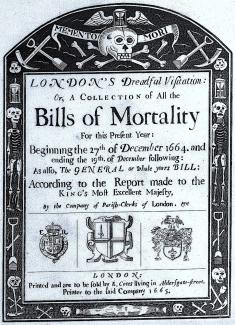
Since at least 1532, London parishes had been keeping death records. Beginning in 1603, these records were compiled into weekly public documents called the Bills of Mortality. The main purpose of the Bills at the time was to track bubonic plague outbreaks, allowing citizens to identify infected areas and avoid them.
Over time, the Bills evolved to include baptisms, causes of death and, eventually, ages of death. These data also helped monitor London's population growth, track demographic changes, and compare death rates between parishes.
Recognized today as among the earliest continuous disease records in the world, the Bills captured something no one had yet thought to fully examine: patterns. Week after week, year after year, the numbers accumulated, building a picture of population health that became a puzzle one man would make his mark piecing together.
An Unlikely Epidemiologist
John Graunt was born in London in 1620; he grew up to be a merchant, selling small goods like hats, buttons and thread. He served as a Common Councilman of London and was a manager at the New River Company, which supplied the city with water. He had no formal scientific training, and yet, he is today regarded by many historians as the founding father of epidemiology and vital statistics, the field of science that uses data on births, deaths, and disease to understand the health of a population.
Graunt used his position as a councilman and his instincts as a merchant to gain access to the data in the Bills of Mortality. He began to identify patterns in plague deaths, analyze the population, and identify gaps in data reporting.
In 1662, Graunt published Natural and Political Observations Made Upon the Mortality, commonly referred to as Observations on the Bills of Mortality, a systematic analysis of decades of London death records that would forever change the course of public health — and his findings were truly remarkable.
Surveillance Into Insight
Graunt analyzed differences in deaths between genders, seasons and regions. He was the first to document that more boys were born than girls, but that males died at higher rates, resulting in a roughly equal sex ratio in the population. He noticed that death rates in cities were consistently higher than in the countryside — what would later be called the “urban penalty.”
Additionally, he distinguished between diseases that caused sudden spikes in deaths, which were known as epidemics, and those that killed at a steady, predictable rate, known as endemics — terms introduced by Hippocrates in ancient Greece.
Graunt also wrote about the difference between mortality (from the Latin word mors, meaning “death”) and morbidity (from the Latin word morbus, meaning “sickness”), a distinction to differentiate dying from a disease versus becoming sick, but not dying. These terms were just entering common English at the time, and the way Graunt applied them remains fundamental to epidemiology today.
Graunt was the first to systematically estimate causes of death and identify "excess deaths" during plague years. He was also the first to document what epidemiologists now call “excess mortality” — the observation that total deaths during plague years climbed well beyond the number attributed to plague itself. From this, he estimated that plague deaths were being undercounted by roughly one in four.
For Graunt, death was not simply an individual event. It was a population-level phenomenon that could be measured, predicted, and acted upon.
Questioning the Count
What made Graunt’s work especially significant was not just what he found, but how he approached the data. He understood that the Bills of Mortality were imperfect. A shameful cause of death was sometimes changed to something more socially acceptable and, therefore, was not counted accurately. Additionally, some events were undercounted. For example, christenings were not all included due to families dissenting from the Church of England.
Rather than ignoring these flaws, Graunt accounted for them. He cross-referenced data, looked for consistency across years, and developed workarounds for missing information. In doing so, he introduced two factors that remain critical to assessing and understanding epidemiological data: data quality and source checking.
Epidemic Legacy
Graunt's book was recognized almost immediately as something extraordinary. Shortly after publication, he was elected a Fellow of the Royal Society of London, which was then the most prestigious scientific body in England. This was an unusual honor for a tradesman with no academic credentials. His influence spread quickly, reaching astronomers, mathematicians, and public health officials alike.
The concept of tracking vital statistics became a cornerstone of epidemiology worldwide. The methods Graunt pioneered in 17th century London are embedded in public health practice in the present day. The global surveillance systems that monitored COVID-19 cases, deaths, and hospitalizations in real time were a direct expression of Gaunt’s foundational ideas.
In Sum
John Graunt didn’t set out to change the world as a tradesman and councilman. He was a curious, self-taught man who noticed something in records that had been sitting untouched for decades. Through examination and analysis, he transformed epidemiology from a discipline of individual observation into one grounded in population-level data, laying a foundation that scientists and epidemiologists are still building on today.
Think about it
- How do you think John Graunt’s perspective as a tradesman may have shaped the way he looked at the data?
- Graunt found ways to work around flaws in the Bills of Mortality rather than dismissing the data entirely. Why is it important for scientists to understand that data sources have limitations?
- Why is it important for the public to understand that despite limitations in data that scientists use to draw conclusions, the findings can still be useful and relevant?
Related resources
- John Graunt F.R.S. (1620–74): The Founding Father of Human Demography, Epidemiology and Vital Statistics (Journal of Medical Biography)
- Bills of Mortality: Tracking Disease in Early Modern London (Lancet)
- John Graunt (Britannica)
- John Graunt (Linda Hall Library)
"People Have Been Using Big Data Since the 1600s" (Smithsonian)
Visit the "Exploring Epidemiology" page to download a PDF version of this article.